Perhaps what fascinates me the most about Iranian cinema is the urgent, visceral interaction between the zeitgeist of oppression in the country and the craft the filmmakers use to react to and comment on it. With renowned directors like Jafar Panahi (Offside) and Mohammad Rasoulof (The White Meadows) being arrested and banned from filmmaking by the Iranian regime, the stakes are so high for all filmmakers in Iran that such jeopardy cannot help but coat the characters and stories in their films.
The latest example is Dog Sweat, wherein young Tehranis pursue such innocent desires as alcohol, companionship, and musical expression, all in the face of systematic oppression.
On Wednesday, The United Nations launched UN Women, a new agency devoted to promoting and protecting women's rights around the world, with seats for 41 member nations. Many nations, including Nigeria, DR Congo, and Saudi Arabia applied and were granted seats on this new council. One notable and controversial exclusion was Iran, who applied as one of the 10 members from Asia but was replaced at the last minute by East Timor. The AFP reports:
"They lost and they lost handily," commented US ambassador Susan Rice on Iran's defeat.
"We have made no secret of our concern that Iran joining the board of UN Women would have been an inauspicious start to that board," she told reporters.
The claim of Iran's exclusion being due to their abysmal women's rights record would be easier to buy were it not for DR Congo's and especially Saudi Arabia's easily obtained seats on the council. The epidemic of mass rape in DR Congo would not seem to make the nation an exemplar of protecting women, and Saudi Arabia oppresses their female citizens to such a complete and inhuman degree (they are not allowed to even leave their own homes without the company of either a spouse or blood relative, and of course must remain covered when in public) its like the Islamic Kingdom is trying to win some bizarro Nobel prize for violating human rights.
This is not to diminish the suffering of Iran's women at all; from the Islamic dress code, to being banned from places like soccer matches, to unjust and cruel imprisonment and execution by stoning, the gross mistreatment of Iranian women is legendary and ongoing. But for the UN to imply that Iran's record is worse than a country like Saudi Arabia, the world leader in oppressing women, is just ridiculous. Iranian women outnumber men at universities, and, unlike Saudi Arabia, women in Iran are allowed to go pretty much where they choose, although not without hazarding threats from the Morality Police should a headscarf be out of place or a blouse be too formfitting.
It seems blatantly political that the UN would take care to keep Iran off this new council while accepting Saudi Arabia and DR Congo seemingly without issue. One must not ignore the ongoing sanctions against Iran, which today brought this development:
Nigeria has vowed to report Iran to the United Nations Security Council if Nigerian investigators find evidence that an apparently illegal arms shipment seized in Nigeria violated UN sanctions against the Islamic Republic.
Is Iran's seemingly deliberate exclusion from UN Women yet another sanction against this moment's global pariah? If the United Nations prime concern here was truly protecting and advancing women's rights, then they would keep Saudi Arabia as far away from that council as possible.
Thousands of US government and military documents, obtained by the provocateurs at WikiLeaks, have just flooded onto the Internet and front pages world wide shedding a pale, sickening light on the Iraq War. Perhaps the biggest detail that the papers reveal is just how involved Iran has been in the conflict. The New York Times breaks it down here, and the level to which the Islamic Republic and their Republican Guards have meddled in Iraq is just staggering. Iran has been supplying weapons and given guidance and training to anti-US Shiite militias in Iraq, much the same way they support Hezbollah. Perhaps most astoundingly of all is the revelation of numerous border skirmishes between American and Iranian forces-
- including a Sept. 7, 2006, episode in which an Iranian soldier who aimed a rocket-propelled grenade launcher at an American platoon trying to leave the border area was shot and killed by an American soldier with a .50-caliber machine gun. The members of the American platoon, who had gone to the border area with Iraqi troops to look for “infiltration routes” used to smuggle bombs and other weapons into Iraq, were concerned that Iranian border forces were trying to surround and detain them. After this incident, the platoon returned to its base in Iraq under fire from the Iranians even when the American soldiers were “well inside Iraqi territory,” a report noted.
What these documents make clear most of all is that the current Iraq War is simply the latest in a series of long battles that have made up our 30 year war with Iran, which has its roots in the CIA ousting of their democratically elected Prime Minister in 1953, but began in earnest with the overthrow of the US-backed Shah and the siege of our embassy in Tehran during the 1979 Islamic Revolution. Then came the Iran-Iraq War from 1980-1988, where-in we supported Saddam Hussein against Iran, supplying money and weapons, stationing US war ships in the Persian Gulf, and even shooting down an Iranian passenger plane. Now this latest and bloodiest chapter, and we seem to be losing, what with the persistence of the militias, and Iran's hand print on the formation of the new Iraqi government. As genocidal and maniacal as he might have been, Saddam was the only thing that, for a time, prevented his country from becoming a big Lebanon, which is now what Iraq is turning into.
(Top: Iranian soldiers wear gasmasks to protect from Iraqi chemical weapons during the Iran-Iraq War. photo from Wikipedia.)
Growing up American during this past decade, I have come to think of Iraq and Afghanistan as colonies of the US, as extensions of the soil that is my homeland; I don't think I'm alone. I don't agree with this notion, and on further analysis it breaks down, but the sentiment is so strong I cannot ignore it. Perhaps I have some idea of how many average Brits felt about India, Ireland, and a large swath of Africa back when the sun never set on their empire.
And so, though I've never been to Iraq and it is thousands of miles outside my country's borders, I feel strangely protective and violated when I read about Iran making machinations in Iraqi politics and government-making. The Guardian has the scoop:
Iran has brokered a critical deal with its regional neighbours that could see a pro-Tehran government installed in Iraq, a move that would shift the fragile country sharply away from a sphere of western influence.
This should come as no great surprise; Iran was only waiting for us to pull most of our forces out of Iraq and focus our media and military on Afghanistan. Now they are swooping in to secure Iraq as an ally. And why shouldn't they? The two countries share a large border, and Iraq is 60% Shiite, the dominant sect of Islam in Iran. If anything, the Islamic Republic has more right to help decide Iraq's political fate than the US, if anyone other than the Iraqi people has that right at all.
While addressing the UN General Assembly, the Iranian President took his assholery to a new level:
Ahmadinejad said there was a theory that "some segments within the US government orchestrated the attack to reverse the declining American economy and its grips on the Middle East in order also to save the Zionist regime.
"The majority of the American people as well as other nations and politicians agree with this view," he said.
Naturally, the US delegation walked out, followed by several others. When will insane ideologues stop using 9/11 for petty political attacks? I fear perhaps never.
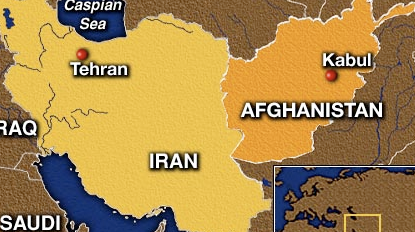
In America, we talk about Afghanistan and Iran separately, as if they are worlds apart, when in reality they share a border.
The way we separate these two countries in our political discourse is completely dissonant. It would be like discussing New Jersey without ever mentioning New York, or visa versa. It's just absurd.Tehran Bureau has a great piece on this very subject: the Iranian-Afghan connection.
After spending several weeks in Kabul, one can hardly deny the extent of Iranian influence in Afghanistan. As a major player in the region, Iran has a vital stake in how its Afghan neighbors are governed. I paid closer attention to this after spending several days with an elite Afghan commando unit tasked with guarding a key site for high-level meetings. These commandos had been trained not only by U.S. Special Forces, but also by the Iranian Revolutionary Guard Corps, the highly skilled paramilitary group accused of arming and training the Shia insurgents in Iraq.
Should it really be a surprise that Iran has such a cultural, political, and military influence on its neighbors? We talk about Iran as if it is some esoteric concept, when really it is sitting right between the United States' two biggest current military commitments, Iraq and Afghanistan. It is a living, breathing country.
I'm reminded of a film by Iranian auteur Majid Majidi called Baran, which explores the relationship between these two countries. It's a really charming, gorgeous, and Chaplin-esque fable about a young Tehrani man who falls for an Afghan girl who works illegally in Iran disguised as a boy.
Just because Iran's Green Movement is opposed to the hardline regime in Tehran doesn't mean they agree with everything the US does either. Case in point: Akbar Hashemi Rafsanjani, one of the opposition movement's leaders, has criticized President Obama's recent sanctions against the Iranian nuclear program. According to AFP:
"The world arrogance (US) is trying to intimidate countries of the region, so they go along with bullying policies against Iran, but will not succeed in this act," Rafsanjani said at a session of the Expediency Council, Iran's top political arbitration body which he heads.
This is a stark reminder that, though there is dissent in Iranian politics, it doesn't simply boil down to anti-American and pro-American. Rafsanjani even uses the word arrogance to refer to the United States, a comparison we usually hear from Ahmadinejad and Khamenei. We need to be careful not to make the strife in Iran all about us.